Free Online CLE Presented by Partner Raymond Dowd & The Westchester County Bar Association

By Firm News, Intellectual Property, Advertising, Art and Fashion Law

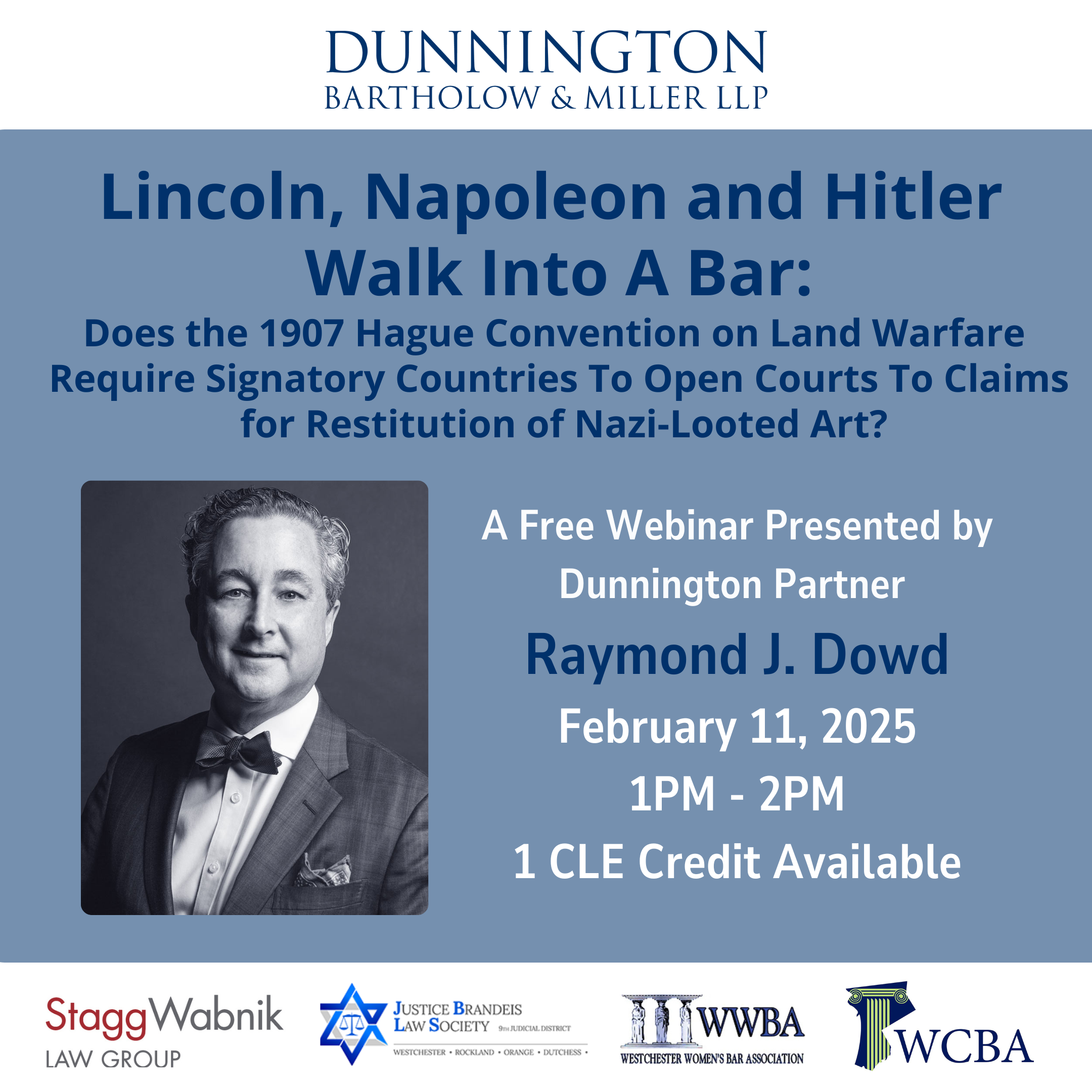
On February 11th, Dunnington, Bartholow & Miller LLP partner Raymond Dowd will present a free online CLE in partnership with the Westchester County Bar Association. One credit in Professional Practice is available. The session is co-sponsored by Stagg Wabnik Law Group LLP, Justice Brandeis Law Society, and the Westchester Women’s Bar Association.

For more information and to register, click here.

Partner Raymond Dowd Speaking at Upcoming Fordham Law Symposium

By Client Alerts, Firm News, Intellectual Property, Advertising, Art and Fashion Law

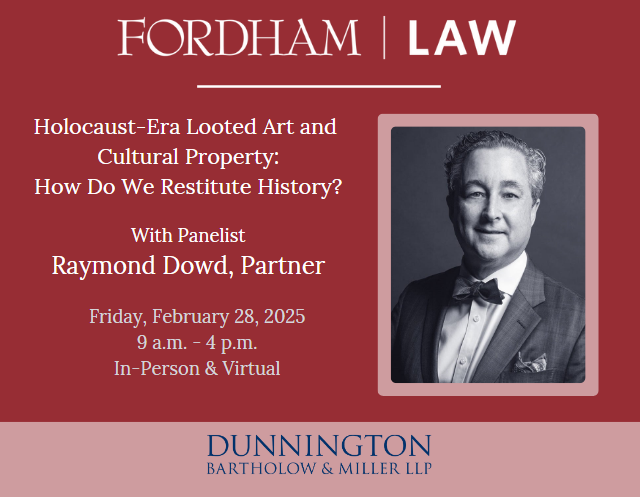
On February 28th, Dunnington, Bartholow & Miller LLP Partner Raymond Dowd will take part in Fordham University School of Law‘s symposium, “Remedies for Looted Art and Cultural Property-Civil, Criminal, or Consensual?” presented by the Fordham Law Review. He will be joined by Christopher McKeogh, Anna B Rubin, and Antonia V. B. for the panel “Holocaust Era Looted Art and Cultural Property: How Do We Restitute History?”, moderated by Judge Hilary Gingold.

For more information and to register, click here.

Trademark Talk – What is a Trade Dress?

By Intellectual Property, Advertising, Art and Fashion Law, Trademark Bulletins

A trade dress refers to the total commercial image of a product or its packaging, which may include elements such as size, shape, color, texture, or even packaging style. The distinctiveness of these elements creates a unique visual identity that makes the product easily recognizable in the marketplace. Think of it as the overall “look and feel” of a product that allows consumers to immediately associate the product with a particular company without ever needing to see a logo or brand name.

The concept of trade dress is encompassed within the definition of a trademark and is therefore protectable under trademark law. To obtain trade dress protection, your product design or packaging must meet two key requirements: it must be distinctive, and it cannot be functional.

The shape of a glass Coca-Cola bottle for example, is protected by trade dress.   The specific blue color that Tiffany & Co’s uses for their gift boxes is also protected by trade dress. As soon as you see the iconic packaging of that little blue box, you think beauty, luxury, and elegance – you think Tiffany’s – even before seeing what is inside.   Similarly, as soon as you see the shape of that classic glass Coca-Cola bottle, you think of that classic cola taste (and perhaps childhood memories of a refreshing drink on a hot summer day).  That’s trade dress, and it is driven not only by branding but consumer recognition.

For a trade dress to be considered distinctive, it must allow the customer to easily identify the product’s source. When a trade dress is so unique that this identification is clear and immediate, it may be considered inherently distinctive. Otherwise, you must prove that your trade dress has acquired secondary meaning. Secondary meaning is when a trade dress, through extensive commercial use or advertising, becomes associated with a single brand in the minds of the public. For example, the shape of a Ketchup bottle, a Birkin bag, or an iPhone, or even the distinctive configuration of a restaurant. These shapes, colors and designs have all achieved secondary meaning through extensive commercial use and advertising.

The second requirement is that the product’s design cannot be purely functional. Design elements are considered functional if they serve a practical purpose or are essential to the product’s use or effectiveness. For example, a shoe sole pattern that improves traction or a bottle shape that makes the bottle easier to hold. Neither of these elements would be protected under trade dress. Trade dress protection covers the aesthetic elements that make up a product’s signature style and unique branding identity, rather than the product’s functionality.

While trademarks are important for safeguarding your brand’s name and logo, trade dress is essential for protecting the overall look and feel of your products. Both serve as powerful tools in protecting your brand’s identity, reputation and market value.

Registration for the 2025 Art & Fashion Law Conference is Now Open!

By Featured, Firm News, Intellectual Property, Advertising, Art and Fashion Law

On February 12 & 13, the Federal Bar Association Intellectual Property Law Section’s 2025 Art & Fashion Law Conference returns to Dunnington Bartholow & Miller LLP. Featuring ten CLE sessions, two keynote speakers and networking opportunities, this two-day conference held in the heart of New York City is a must for those interested in the intersection of art, fashion, and the law. Registration is now open!

A 10% early bird discount will be automatically applied when you register by January 11th.

https://tinyurl.com/3myufzhk

Save the Date: Dunnington’s 2025 Art & Fashion Law Conference

By Uncategorized

Save the Date!

Dunnington’s annual Art & Fashion Law Conference will be held on February 12 & 13, 2025.

Featuring 10 panels across two days, the conference will span a breadth of the latest issues in the art and fashion law sectors, provide networking opportunities, and offer CLE credits for new and experienced attorneys. Registration will open next week.

Upcoming CLE featuring Partner Jay G. Safer – “Advanced Trial Tactics: Practical Considerations for Cross-Jurisdictional Litigation”

By Uncategorized


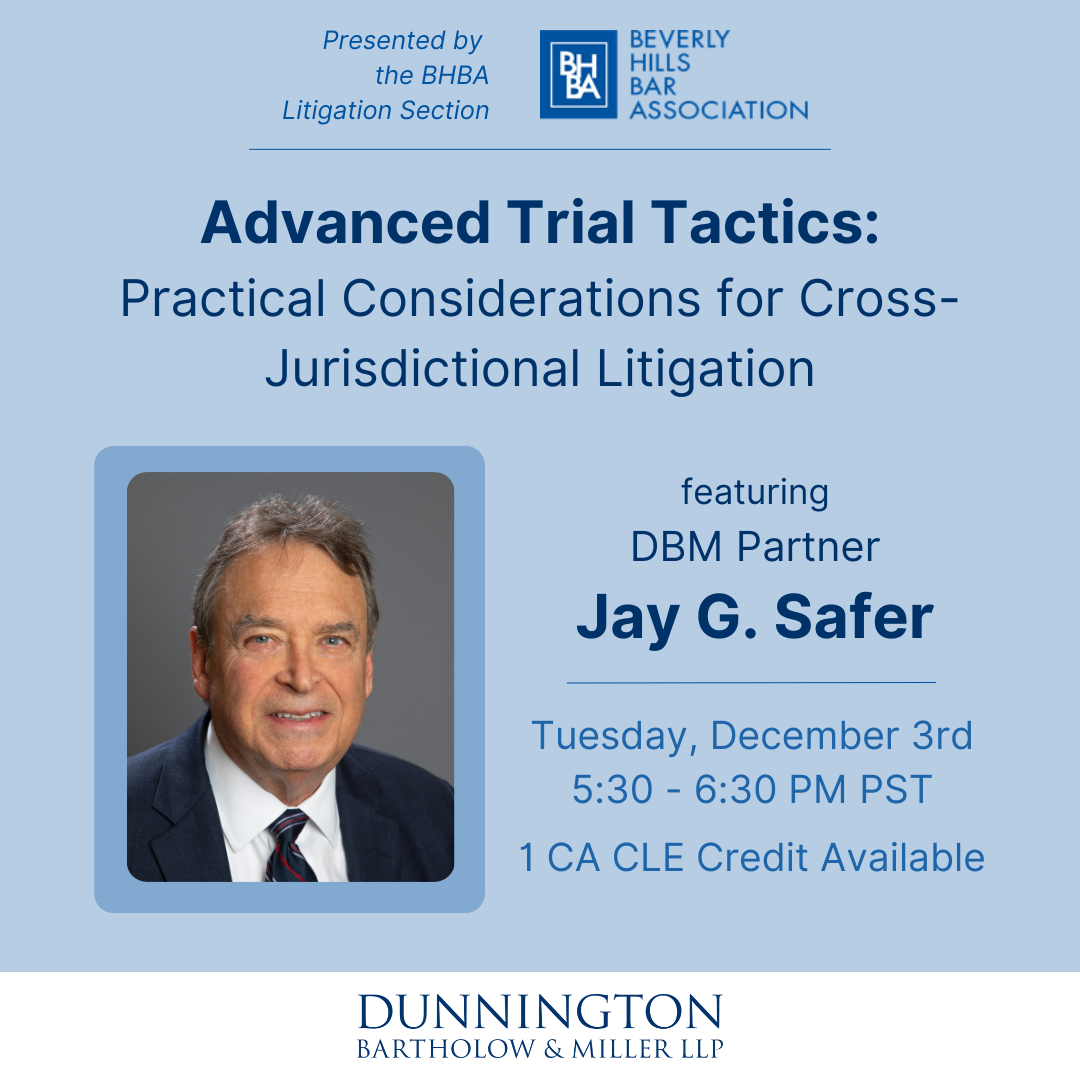
On December 3rd, Dunnington, Bartholow & Miller LLP partner Jay Safer will present an in-depth look at the ethical and practical aspects of conducting litigation across state lines in a CLE webinar hosted by the Beverly Hills Bar Association Litigation Section. Mr. Safer will be joined by speaker David D. Samani and moderator Sidney Kanazawa. One California CLE credit is available (eligible for credit in additional jurisdictions; see website for details).


For more information and to register, click here:

https://myemail.constantcontact.com/Advanced-Trial-Tactics–Practical-Considerations-for–Cross-Jurisdictional-Litigation.html?soid=1102591689817&aid=ljaXY2pZGJw

Getting Real About Real Estate: What Is a “FIRPTA” Affidavit and Why Do I Need to Provide One?

By All, Featured, Real Estate, Real Estate Bulletins

Whenever you sell real property in the United States, the buyer will require you to sign a FIRPTA affidavit swearing that you are or are not a foreign person. FIRPTA refers to the Foreign Investment in Real Property Tax Act of 1980. Here is a link to a detailed explanation of FIRPTA from the Internal Revenue Service.

Why does a purchaser require the information as to whether or not you are a foreign person?

Because the IRS will charge the purchaser any tax that you, the seller, might owe if it goes unpaid.

But what does that have to do with being a foreign person? Well, the IRS doesn’t trust a foreign seller to pay any tax owed if the foreign seller takes the proceeds overseas after closing the sale.

This IRS concern gives rise to the dreaded “FIRPTA tax withholding” requirement. FIRPTA requires both parties to the sale, i.e., the purchaser as well as the seller, to account at the time of closing for any tax owed on the sales proceeds by the seller. Either the seller convinces the IRS ahead of the closing to grant an exemption from any tax or – more likely – the parties put 15% of the sales price into escrow until the seller gets the exemption or files their tax return.

And because the IRS will take its 15% from the purchaser if it isn’t put aside at the time of closing, the purchaser will do whatever it takes not to lose that money. Which means that the purchaser has two options. One: the purchaser gets an affidavit from the seller that the seller is not a foreign person subject to FIRPTA; Or two: the purchaser gets the seller to agree to put 15% of the sales proceeds aside at the closing, usually by giving it to the purchaser’s title insurance company to hold in escrow, until the seller takes care of the IRS by getting an exemption or filing a tax return and paying whatever tax is due.

So, this is why you need a FIRPTA affidavit when you sell real property in the US. Aren’t you glad you asked?

by Andrew Weltchek

New Member Announcement: Andrew Weltchek, Of Counsel

By Firm News

Andrew Weltchek is a member of Dunnington’s construction, real estate and litigation, arbitration and mediation practice groups. He counsels owners of commercial properties in New York City on closing sales and purchases, dispute resolution and settlements, both in and out of court. In 1992 he transitioned from the Real Estate Finance Bureau of the New York State Attorney General’s office into private practice. Along with commercial real estate, Mr. Weltchek has experience defending Americans with Disabilities Act claims and knowledge of Condominium and Cooperatives Law in New York City. Read More

Getting Real About Real Estate: Why Should Real New York Real Property Owners Really Care About the Rule Against Perpetuities?

By All, Featured, Real Estate, Real Estate Bulletins

Believe it or not, New York real property owners should be aware of the “rule against perpetuities” when structuring transactions – the rule arises in many more cases than you think.   New York’s rule against perpetuities is taught in the first year property courses of law schools, included in bar review courses, and usually promptly forgotten.

But that’s dangerous.  I’ll explain why.

Here’s the Rule Against Perpetuities in NY: “No estate in property shall be valid unless it must vest, if at all, not later than twenty-one years after one or more lives in being at the creation of the estate and any period of gestation involved. In no case shall lives measuring the permissible period of vesting be so designated or so numerous as to make proof of their end unreasonably difficult.” EPTL 9-1.1(b).

Got it?

I thought not. The short version is that no interest in real property is any good unless is vests, that is, comes into being, no later than twenty-one years after a life in being as stated in the instrument creating the interest, such as a deed, will, or contract.  And if there is no “measuring life” mentioned then you count twenty-one years from the date of the instrument.

Here’s why you should care.

For one thing, you should care because you are going to die and you want to plan for what happens to your property when you do. But if your plan is not careful, it might violate the Rule Against Perpetuities and your property goes nowhere but to court where your survivors fight over it.

For example, you could will your house to your sister for life and then to the oldest of her surviving children when they turn 30. This violates the Rule Against Perpetuities because it’s possible that no one alive today will receive the interest. For example, if your sister’s children die, and then she has another child and dies, the interest might not vest in anyone alive.

Or for another example suppose you will a building you own to your sister, so long as it is never used as a bar or restaurant, in which case it goes to your brother. That violates the Rule Against Perpetuities because it is possible for the interest to vest — someone opens a bar in the building and it goes to your brother’s heirs — more than 21 years after the death of everyone involved when you willed the building to your sister. Thus, the conveyance is not valid.

But what about while you’re still living, should you care about the Rule Against Perpetuities then? Yes.

But why, you ask? I’ll tell you.

Let’s suppose you own a nice little building in Brooklyn with a small grocery you run on the ground floor and two nice apartments upstairs, one of which you live in and one you rent out. And suppose further that knowing that you are going to die someday you decide you don’t want to spend the rest of your life selling groceries. So you decide to sell your building, take the money, and live out your days on the beach.

But you care about your neighbors and what could happen to them after you leave. In particular, you don’t want their children to be exposed to drugs. And now that pot is legal, you don’t want anyone to turn your bodega into a cannabis shop.

So you tell your lawyer you want your deed to prohibit anyone who buys your building from operating a cannabis shop there or else the property will go to your son and his heirs. Sorry, no you can’t, says your lawyer. That would violate the Rule Against Perpetuities because there is no time limit on when someone could open a cannabis shop and lose the building to your son or his heirs.

Finally, let’s suppose your next-door neighbor comes to you asking to buy your building to turn it into a single-family home for him and his family. And you say thanks, no thanks, you’re not ready to move to the beach — and anyway, the little old lady who lives in the other apartment with her grandkids is protected by rent control and it would be too nasty and expensive to get her out.

Then the neighbor says that’s ok, he can wait. He just doesn’t want you to sell the building to some stranger when you’re ready to go. So he asks you to sell him the grocery now and the apartments later whenever they are vacant.

So you ask him how you can do that. And he says, you sell him a one-third interest in the building and agree on a price to buy the other two-thirds whenever the apartments are vacant. In the meantime, you and he own the building together as tenants in common with an agreement that he collects the rent from the store and pays one-third of the building’s operating costs.

You say yes. You and he sign a contract to sell the one-third now and the two-thirds at a given price later whenever the apartments are vacant. You deed him his one-third interest in the property — and then you wait, and wait, and wait. And the little old lady dies and her grandkids stay in the apartment as rent-controlled tenants. And you wait some more.

Years later after you and the grandkids have moved and the apartments are finally vacant, your co-owner says he’s ready to pay the option price to buy your two-thirds interest in the building. But now the fair market value of the property is much more than the option price and you don’t want to sell your interest at a discount.

Instead, you say that the option agreement is no good because it violates the Rule Against Perpetuities because the option agreement sets no deadline for when it can be exercised. So you refuse to give up your ownership interest in the building at the now-low price you agreed to all those years before. Then your co-owner sues you to see if a judge will order you to sell your interest in the building at the option price.

And that is another example of how the Rule Against Perpetuities works and why you should care about it.

These are real problems that real people have with their real property in New York.

If you have real problems with your real property in New York, call Dunnington to find a solution.

by Andrew Weltchek